The list
There’s little reason to believe the physical library can contain an e-lending service unless it’s very tightly controlled as described here. The demand for especially digital audiobooks is continuing unabated and control mechanisms tend to be crude and self-harming as described here. The alternative then is to embrace the digital literature in all its expanding glory and give it a home of its own; i.e. an actual digital public library.
Whether a digital library can ever be a library in the sense that we understand a public library or whether the two can co-exist peacefully perhaps even with some synergy, I’ll leave to deeper thinkers than myself. Evidence suggests there won’t be much interaction between the two. However, the objectives and ultimate yardstick of success are similar in many ways. See below.
First, I want to touch upon a list that my co-blogger wrote down a while ago. He’s graciously allowed me to use it even though it’s only a sketch. The list enumerates necessary steps to solving e-lending. At least the acquisition part of it.
The Swarthout list (a sketch):
- Clearly define a target audience and a collection
- Be able to access the needed titles viz. cost and T&Cs
- Get the service into the hands of the intended users
- Have appropriate control of the technology
- Resolve the issue of whether we need to own the books
- Maintain a stable relationship with publishers
I ran it by the NAPLE expert group on e-lending and asked them to rate the items with each participant having 100 points to distribute among the items on the list. It was a close race!
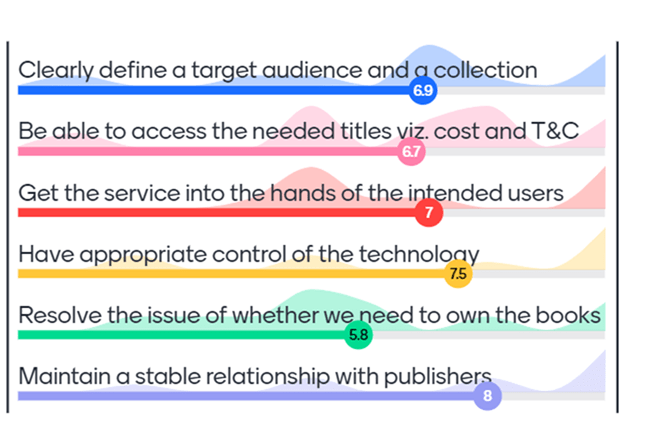
Fig. 1: Voting on the list items
The acquisition part is causing major issues all over the world especially in the English-speaking world, but of course solving the acquisition issue is just half the battle. Just as Cato, the Roman senator, relentlessly pushed his main geopolitical idea by ending all his speeches with “Furthermore, I believe that Carthage must be destroyed,” I have ended all my communications on e-lending with “Furthermore, we need to talk about all the consequences of a possibly successful e-lending scheme.” Again; see this post for more on that.
What a digital public library might look like in broad terms and why it might not be that different from its physical sibling, I’ll introduce by presenting the Copenhagen value pyramid for libraries and a quick thought experiment.
The pyramid
One of the best illustrations of what a digital library should do is by my boss in Copenhagen, Jakob Heide Petersen, who produced a hierarchy of value adding in the library in the form of a pyramid. Tellingly, it started off describing the physical library and was later modified to describe the digital library. If hardly solid proof it does indicate that despite all their differences the physical and the digital library are closely related. Note that the digital library here is envisioned as a gateway to the physical library as well.
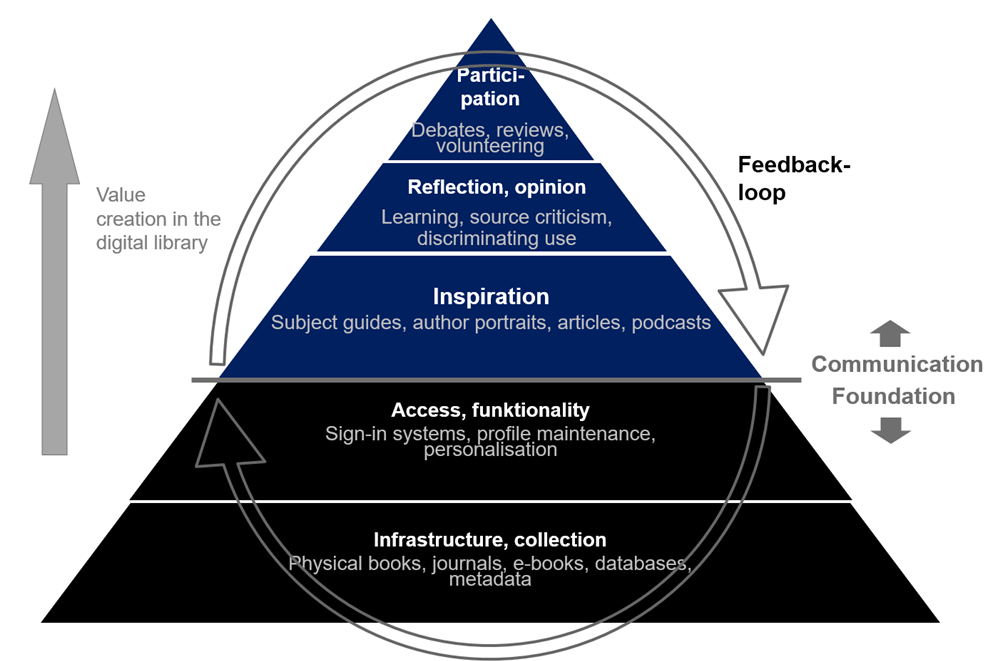
Fig. 2: Adding value in the digital library
The pyramid is split in two parts consisting of two infrastructure steps and three communication steps respectively with feedback loops between the two parts. As I tend to accuse e-lending for reducing the library to transactions without the engagement, I’ll rename the top part the engagement part in the future.
The higher you go in the pyramid the more value the library has had for the individual patron. It doesn’t mean every interaction and relationship with patrons ends at the top or even should end at the top, but just that the most value is there.
The pyramid is read as follows. The library builds a technical infrastructure which is the basis for everything else. This makes possible the building of collections and services on top of the infrastructure.
With the infrastructure part in place, patrons can access the digital library and at the very least we hope to inspire them. Endless debates about what digital collections the library should have, what target groups if any and how to inspire patrons in what ways are certainly possible and should be had. In Denmark, children and young people are our primary target groups and the development policy for our digital collection – our e-lending platform – is focused on Danish literature, quality literature (as opposed to popular literature where these two differ), narrow literature and the back catalogue more so than the front.
Building on inspiration we hope to make patrons more discerning in their literary or cultural consumption. Indeed, the mission of Copenhagen Libraries is “Avid readers, discerning cultural consumers, engaged citizens.” The final step is to make patrons participate in cultural activities. This is where the library has had the biggest impact on the patron; added the most value.
What we learn about our infrastructure, collection and services by making them available to patrons will lead to necessary or strategic changes which in turn will change patrons’ use which will lead to further changes in an ever-ongoing feedback loop illustrated by the arrows.
Below I have re-arranged the Swarthout list in a way that makes the most sense to me and I have added a few words to item no. 2:
- Clearly define a target audience and a collection
- Be able to access the needed titles viz. cost and T&Cs while keeping total costs manageable
- Resolve the issue of whether we need to own the books
- Have appropriate control of the technology
- Maintain a stable relationship with publishers
- Get the service into the hands of the intended users
It’s clear that the list exhausts the acquisition part of the issues but also that it only barely breaks through the infrastructure – engagement barrier of the pyramid. We need a plan for the rest! Not only what but also how and by whom.
Joining the list and the pyramid and adding an item 7 to the list, it looks like this:

Fig. 3: The list and the pyramid: the case for item 7
Walking into Copenhagen Main Library
As a thought experiment let’s enter Copenhagen Main Library. The first thing to hit you when you’ve negotiated the revolving doors is the smell of coffee and freshly baked croissants from the café. Historically, this has ruined all attempts by me to stay off carbs. It’s also a little bit difficult to replicate online. Then you see the mainstays of all public libraries everywhere; books and visitors and upon closer inspection exhibitions and notifications of events and other offers such as book clubs, IT training classes etc. And staff.
Of course, a digital library will have books and lots of them. It can also easily offer online events and classes. We had great online events during COVID lockdowns. Also online book clubs, forums for discussion, all sorts of social interaction. A digital library can offer a plethora of literature promotion, discovery and other inspiration. Staff can run discussion boards, book clubs, do talks, be available for chat etc. The only real problem is the sense of physical space and human interaction in that space. You could argue that that is the game right there, but it’s not a problem isolated to the physical vs. the digital library, but rather everything physical vs. digital. I’m “working with the available nails” here as we say in Danish.
Better yet, in Denmark (5.8 mn. people) the public library is run by the municipalities of which there are 98. There are about 300 library locations in the country. Some of these are pretty small of course, but then much of the digital library could be national to ensure critical mass; e.g. enough people for the more esoteric literary interests and enough to merit an always manned chat hotline for instance. Also, Photoshop and Excel are similar in the north and south of Denmark. No reason to wait for your local library’s class to be filled. Literature promotion, inspirational activities, discovery etc. could be done by the best in the country and not the best in the municipality. This is essential when competing for people’s attention online as I’ve lamented before.
Best of all, though, there’s no reason this could not be the hub for all things literature drawing on the skills associated with librarianship as well as the reputation of the public library as one of the most trustworthy institutions in society (librarians place #4 in “most trustworthy profession” surveys in Denmark behind midwives, nurses and doctors respectively).
What we’re working in in Denmark is a bit different. Here, we’ve identified the local library as the primary hub, because the institution in people’s hearts and minds is the local library, and the local library is the one fighting for municipal funding. However, the local library should not spend its limited resources fighting a national or even international war for attention and traffic and so it will draw upon national services which will populate the web site and give access to national coordinated services such as eReolen through apps. And so most things digital will be nationally coordinated, but the local library is the sender.
PS: Two years ago while we were talking about the effects of lockdowns on digital literature use while walking through a beautiful wintery park in Copenhagen, the sales exec of the largest Danish digital publishing house said to me somehting to the effect of: “I really think the public library should build a national digital branch; a national digital library. THE place online for literature. You’re the only institution able to build such a site. Anything commercial will be limited and skewed. I also think you need to!”
—
Next up: The rise and rise of audiobooks
 Intercontinental Dialogue on eBooks and Public Libraries